|
LOCATION
Altitude:2,230 Meters a.s.l.
Distance:1,020 km. From Lima.
180 km. From the Colca Valle. 400 km. From Tacna.
Population
619,156 Inhabitants (City).
GETTING THERE
The South Panamericana Road Branch Leads up From the
Coast to Arequipa and it Also Goes From Lima to Tacna.
There are 1,020 km (632 Miles) Between Arequipa and Lima
and 400 km (248 Miles) Between Arequipa and Tacna.
By Air, There are Daily 1 -Hour Flights from Lima to
Arequipa, 30-minute Flights From Cusco, and 20-Minute
Flights From Tacna or Juliaca.
The Trip From Puno to Arequipa by the South Railroad
Takes 10 Hours, Leaving on Mondays, Wednesdays and
Fridays. Arequipa is the Capital of the Province,
Department and Region of the Same Name. It is Located at
2230 Meters (7,314 Feet) a.s.l. it is the Second Largest
City of Peru. One of Its Main Attractions is the Fact
That Arequipa Has Probably the Nicest Weather of Peru
With an Average of Maybe 300 Sunny Days a Year. The City
Keeps its Ancient Architectural Treasures, but Also
Shows a Modern Side with Many Luxurious Hotels and
Casinos. Arequipa Gives Tourists the Opportunity to
Spend a Pleasant Time in the City and its Outskirts. It
is also the Departing Point for Wider Circuits.
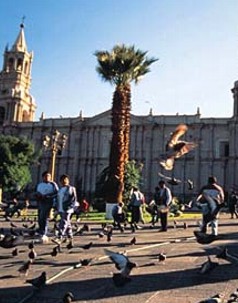
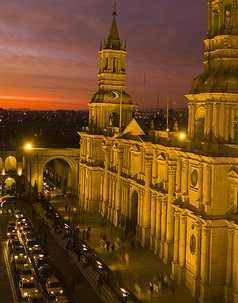
Once in the City,in theMain Square, the Church 'La
Compañia de Jesus', Which Has Cloisters with Ashlar (Volcanic
White Stone or 'Sillar”) Arcades and the Renowned Santa
Catalina Convent Should not be Missed. On the Outskirts
of the City Some Districts Stand Out Because of Their
Beauty, Like Cayma, This Temple was Built in 1730, or
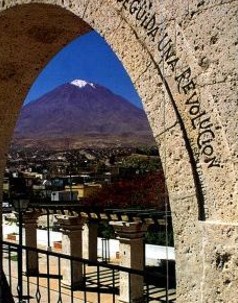
Yanahuara, which Gazebo Offers a Great View of the City
Surrounded by Volcanoes, such as Cachani, 1,076 Meters
(3,529 Feet) a.s.l,the Misti 5822 Meters and the Pichu-Pichu
With 5664 Meters
Also Important are the Yura Chapel, the San Lazaro
Quarter the Sabandía Mill and the Añazhuayco Quarries,
From Where the Ashlar ('Sillar') is Extracted. Arequipa
is known as 'La Ciudad Blanca" (White City) Because of
the Color of its Ashlar Buildings.
MEJIA LAGOONS
The Mejia Lagoons National Sanctuary (Santuario
Nacional de Lagunas de Mejia) is Located on the Coast of
Arequipa, Near the Mouth of the Tambo River, 20 km (12.4
Miles) South of the Port of Mollendo and 150 km (93
Miles) From the City.
It is an Isolated Ecosystem and the Only Vestige,
Between the North of Chile and Pisco, of the Ancient
Flooded Lands That were Part of the American Coast,
Drained for Agriculture for Centuries. In Spite of Being
Located at Sea Level and 170 S Latitude, the Annual
Average Temperature in the Mejía Lagoons is Usually 18º
C (64.40 F), Under the Effect of the Peruvian (Humboldt)
Warm Stream.
The Lagoons are Separated From the Ocean by a Large
Fringe of Beaches and Sandy Pits. Within the Protected
Area (690 Hectares/1,704 Acres), Several Habitats are
Grouped, Including Lagoons of Different Degrees of
Salinity, Salt Marsh, Reed Patches, Salt Mines and Wild
Grass That Form a Complex Ecosystem. This Particularly
Valuable Scenario Homes 157 Bird Species, of Which 72
are Residents, 62 are Regular Visitors and 24 Sporadic
Visitors. Conservationist and Investigation Efforts are
Being Made Today to Entirely Preserve This Natural
Treasure.
AGUADA BLANCA AND SALINAS
Behind the Misti Volcano, as Seen from the city,
Over an Extensive Plain at 4,000 Meters (13,120 Feet)
a.s.l. is the Aguada Blanca Dam, Declared a National
Reserve. It is a Rather Shallow and Artificial Lake
Originated by the Blanco River Containment. A Little to
the South, Behind the Pichu Pichu Peak, is an Even
Larger Lagoon Called Salinas. These Lagoons are a Place
for Resting and Nesting for a Large Population of Birds
Like the Colorful Flamingos. There is a Strong Migratory
Relationship Between These Birds and the Ones From
Mejía, 180 km (111.6 Miles) From Salinas.
PAMPA CAÑAHUAS
Located at the Aguada Blanca National Reserve, Behind
the Chachani Peak. At about 4,000 Meters (13,120 feet)
a.s.I. This Larger Plain Represents One of the Best
Habitats for the Protection of Vicuñas a Peruvian
Camelids, Internationally known for its Fine Fleece. In
Pampa Cañahuas, These Animals Can be Seen Running
Completely Free and, Therefore, Without the Shyness and
Apathy That Seems to Characterize Them Under Captivity.
THE COLCA VALLEY
To the North of Arequipa is the Higher Course of the
Colca River Valley Which Deep Canyon is Renowned Among
Rafters. The Section Previous to the Canyon Consists of
an Encased Valley That Runs From East to West, Beginning
in the Cold Puna and Running Down to Warmer Regions,
Showing its Great Scenic Beauty and Cultural
Attractiveness.
COLCAS
One of the Survival Skills of the Ancient Colca People
Was the Ability to Store Large Amounts of Grain for Hard
Times the Warehouses, known as 'Colcas', Gave Name to
the Valley. In the 'Cool' Caves of Pumunuta, it is
Possible to See Circular Colcas Meter (3.28 Feet) in
Diameter, Made of Mud and Straw.
CRUZ DEL CONDOR
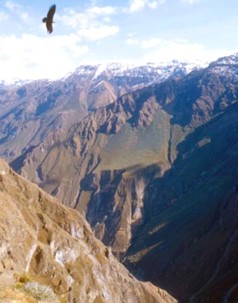
Usually, in Such a Deep Valley, the Rising Winds are
Surprisingly Strong Which Big Condors Take advantage of
to Soar into the Sky Easily.
Between Maca and Cabanaconde, Where Winds are Even
Stronger, is the Cruz Del Condor, an Observation Point,
Perfect for Watching the Condors While They Fly
Majestically.
RAFTING ALONG THE COLCA-MAJES RIVER
From December to March, Expert and Trained Rafters Can
go Along the High and Middle Section of the River,
Explored by the 1979 Polish Expeditions. It Includes
Every Difficult and Isolated Rapids, as the Towns are
Far From the Torrent. Although the Low Section May be
Ran Over in Rubber Rafts, only Expert People, Trained in
kayac Rafting Can do it in the Canyon Sections.
The Name of the Colca River Changes as it Flows Down to
the Pacific Ocean, Past the Canyon; its Name is Majes.
Here, There are More Chances For Tourists to go in
Rubber Rafts. The Chances of Finding Shelters and Access
Ways are Better. Although it’sa Navigable Section (Andamayo-Aplao
River) Does not Have Long Rapids, the Beauty of
theLandscapes and the Clean River Course Allows you
Enjoying the Comfortable Trip. The Area is Open Year
Round to Visitors.
ETHNIC RICHNESS
An Ethnic Group, Bearer of Ancient and Still Strong
Traditions, has Dwelled the Valley for More Than 2,000
Years. They are the Collaguas Who Arrived to the Colca
Valley From the High Regions and Seem to be Descendants
of the Aymaras Because of Their Language and Customs.
Even Under the Inca Dominion, They Kept Themselves
Relatively Independent, and Preserved Their Own
Traditions. It is Told That the Supreme Inca Mayta Capac
Married a Collagua Princess in Order to Formalize the
Conquest of the Valley, and he Built for Her an Elegant
Country House Made of Copper, Near Sibayo.
PETROGLYPS
The Early Settlers of the Valley Left Their Own Peculiar
Trace in Petroglyphs Such as Sumbay and Toro Muerto.
Dancers With Bizarre Headdresses, Different Mammals,
Condors, and Lines of Unbreakable Codes Encompass the
Repertory of Vast Figures.
CHURCHES
There are Almost 20 Towns Along the Valley, Which People
Preserve the Ethnic Richness of Their Past More Than Any
Other Region of the Country. The Main Ones are Chivay,
Cabanaconde, Huambo, Maca, Achoma, Yunque, Larl and
Coporaque, all Very Religious Towns, Whose Catholic
Faith also Keeps Alive Pre-Columbian Elements. Each Town
has its Own Church, Bearer of its Hispanic and an
Example of Architectural Sobriety and Purity Based on
the Ashlar Stone.
VALLEY OF THE VOLCANOES
Entering the So Called'Valley of the Volcanoes" of
Andagua Means Going Back Several Geological Eras to
Witness Some Outstanding Phenomena That Only Happen in
Two Places In the World: the Canary Islands and In this
Arequipa Valley.
The Andagua River Valley Runs Along the Foothill of the
Great Coropuna Volcano, the Highest in Peru and the
Tenth Highest in South America. Geothermal Activity In
This Area has Given Birth to About 80 Volcanoes, all of
Them Extinct Which Give this Area a Moonlike Aspect.
Later, the Andagua River Disappears in a 17 km (10.5
Miles) Stretch, Running Under the Ground Between the
Chachas and the Mamacocho Lagoons Before Flowing into
the Colca. Andagua can be Reached Only by Highway From
the West.
HOT SPRINGS
Because of the Volcanic Nature of the Region, There is
Hot Springs in Different Areas of the Valley. The Main
Ones are Yunque, Chivay, Callalli, La Calera, Huancarama,
Yura and Jesus. Furthermore, These Hot Springs are
Frequently Related to 'Puquiales", Natural Sources of
Cold, Extremely Pure and 100% Potable Water.
Spectacular Airplane Flights are Available Allowing a
Unique and Extraordinary View of the Main Attractions of
Colca That can Only be Seen From the Air. There are
Landing Strips in Huambo (in the Canyon), Orcopampa (Near
the Valley Volcano), Coporaque (the High Part of the
Valley), Tiabaya, Near Arequipa and Also From the City
Airport.
|