|
|
|
MARAS MORAY
EXCURSION |
|
|
| |
|
The Price is $ 65Per person based
on Group Guided Tour
The Price is $ 154 Per person based on 2 people with
Private Guide *Group guided tour available on: Mondays, Wednesdays and
Fridays
|
| |
|
 |
| |
|
|
 We
will pick you up from your hotel at 7:45 am for a tour
in the valley south where you can visit the following
sites: We
will pick you up from your hotel at 7:45 am for a tour
in the valley south where you can visit the following
sites:
MARAS : In the town of Maras, can see the snowy mountain
of the Incas Sacred Valley and the Vilcabamba. At
present this district keeps attractive pre-Hispanic,
colonial and republican, highlighting people in the
colonial doorways with coats of the nobles and
chieftains from the sixteenth and twentieth century’s.
Split the town of Maras two routes, one to the
archaeological complex of Moray and the other to the
salt mines of Maras, each with an approximate distance
of 4 km.
SALINERAS: OR "SALT MINES": Located northwest of the
town of Maras consist of about 2000 small wells, which
were already exploited since Inca times as a means of
economic exchange and is still being exploited by the
locals.
The small wells with an average area of about 5 m²,
built on the side of the slope of the mountain of "Qaqawiñay"
during the dry season is fill or "water" every 3 days
with salt water that comes from a natural spring located
at the top of the wells to the water evaporates, the
salt contained in it gradually solidifies. This process
will continue for about a month until a considerable
volume of solid salt, about 10 cms. height from the
floor, which is then beaten and well granulated, the
salt is then bagged in plastic bags and shipped to
markets in the region today that iodized salt is still
so its use is not harmful.
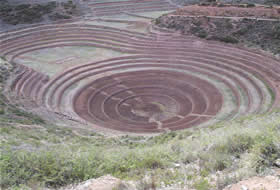
MORAY: Archaeological group unique in the region. It is
famous for its sunken amphitheater, formed by four
circular terraces which seem to disappear within the
highlands, by way of an artificial crater. Apparently,
the place was an Inca agricultural research center
dedicated to the experimentation of cultures around the
different altitudinal levels of the plots (some more
than 100 m deep). The terraces, retaining walls built on
filled with fertile soil and watered by complex
irrigation systems, allowed to grow more than 250 plant
species.
The gallery has a depth greater than 45 m and the
average height of each platform is 1.80 m. It is
considered that the site was an important center of
agricultural experimentation during Inca times. Through
the use of concentric terraces because the temperatures
at each level are different from each other, have played
all the ecological zones covered by the rule of
Tahuantinsuyo.
Besides being considered for Incas as a place of
concentration of female energy, which is considered as a
magnetic center of the Pachamama.
At the end, return to Cusco arriving at 1:30pm
approximately at the main plaza.
END OF OUR SERVICES. |
| |
| |
|
|
Pick up and drop off at your hotel
Entrances
English speaking guide
Buffet Lunch
Group of 15 to 25 people |
| |
|
International or domestic airfares
Lodging |
| |
| |
| |
|
 |
| |
|
| |
|

Mon-Fri 9 Am - 6 Pm ET
please allow pop-ups
|
|
|
|
| |
|
Call Centers |
|

NORTH AMERICA TOLL FREE
Monday - Friday
From 9 am to 6 pm ET
1 888 671 2852 voice
1 888 671 2853 voice
Discounted Airfares Toll Free
1-866-856-8368
1 480 247 4242 Fax

United Kingdom - TOLL FREE (Freephone)
0-800-098-8450

Australian Customers TOLL FREE
1-800-194078
Rest of the world
+51 1 4443027 - 4457704
|
|